I interviewed some pretty incredible Marines over the last two visits with 3/7. They are typical of young fleet Marines. Cocky and filled with bravado, they call themselves an “old guy” or a “senior Marine” as a Lance Corporal (E-3) or Corporal (E-4). I chuckle to myself, as many were merely toddlers when my troops and I deployed for our first wartime experience during Operation Desert Shield. They enlisted in 2003, their recollection of September 11th simply a distraction that captivated their parents while their attention was focused on their next algebra exam or football game at school.
Barely out of high school, the youth of these young men is apparent. They love their video games and Sony Play Stations; they boast about their girlfriends and make plans to get an apartment with 3 or 4 of their friends when they return to CONUS, splitting their expenses to save money for beer and parties. Yet outside the wire, they magically transform into completely different individuals. Gone is the boyish grin, the horseplay and the thoughts of home. These attributes are replaced with steely grit and determination, strength and courage. They are all business, every bit of energy and every ounce of concentration focused on the mission and the safety of their fellow Marines.
These young men have experienced things that took my generation an entire career to experience. I’d like to mention a few of these young men, the future leaders of our Corps, and the reason we are still able to enjoy our freedoms at home, safe from the threats these Marines face on a daily basis.
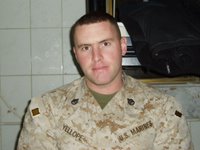
There’s SSgt. Andrew Yellope, Weapons Company, 3/7. He joined the Corps at age 17 and was deployed to Afghanistan during the initial phase of Operation Enduring Freedom (OEF). One evening, while sitting in a defensive position near Khandahar airfield, an illumination round set the brush on fire in front of his unit’s position. Over the next hour, twenty-six mines proceeded to blow up from the flames, the area laden with mines and unexploded ordnance. He escaped without a scratch and currently faces a similar threat of unexploded mines and IED’s in the mean streets of Ramadi.
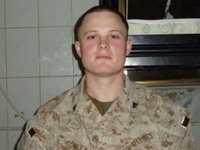
One month ago, Corporal Matthew Conley’s platoon from Weapons Company was serving as the Battalion quick reaction force, or QRF in Ramadi. Lima Company hit and IED, then shortly thereafter, a secondary IED went off in the same vicinity. Corporal Conley and his squad arrived on scene within 7 minutes from receiving the call and assisted the severely wounded Marines, some with legs and feet missing from the effect of the explosion. They quickly hauled the wounded to “Charlie-Med,” the surgical facility at Camp Ramadi, only one Marine losing his life due to the quick reaction of Marines like Corporal Conley.
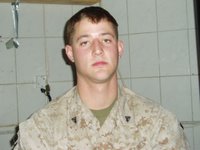
Kilo Company’s Corporal James Dodson, Jr. received his baptism by fire on April 17, 2003, during the battle for Husayba, a small town along the Syrian border. The city was crawling with organized bands of insurgents suspected to number around 300 strong. While pushing through the city on foot, Marines in another squad were wounded and Corporal Dodson’s team filled in the gap, taking heavy fire from insurgents who had set up sandbagged machine gun positions. Fighting the way through the cramped alley ways, he and his team spent the next three nights on a rooftop, sitting on overwatch to ensure the insurgents couldn’t escape 3/7’s noose slowly tightening around the city.

Corporal Adam Frickey, India Company 3/7, was conducting a patrol near an abandoned house in Ramadi and got a funny feeling when he passed an abandoned building. Taking a quick peek inside, he found himself staring at an insurgent strong point that had been recently vacated. Lying inside the room was a box containing 14 mortar rounds, grenades, and other ordnance and weapons that could have been used against his buddies or himself. Shortly afterward, his company conducted a sweep near the Euphrates that recovered approximately 90 AK-47’s, countless rocket propelled grenades (RPG’s) and launchers. All in a days work.
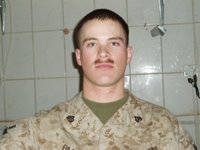
Like Corporal Dodson, Sergeant Ryan Bilbao, Platoon Guide for Kilo Company, found himself embroiled in battle with insurgents in the streets of Husayba in April, 2003. He recalled receiving a quick warning order and loading onto trucks to conduct a sweep of the city. Under sustained small arms fire, his platoon walked block by block to clear houses and building through the middle of the city, from east to west, all while being engaged by insurgents hidden within the city walls. In addition to his standard combat load, Sgt. Bilbao carried nearly 1400 rounds of ammo for his M-249 squad automatic weapon (SAW), a total weight in excess 100 lbs. He scanned overhead as Cobra gunships and FA-18’s rained fire from above onto the insurgents and their hideouts.
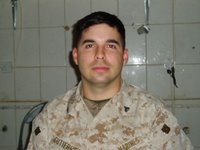
Cpl. Phillip Gutierrez recalled his first ride into battle on the back of an MTVR 7-ton truck. Excited and scared at the same time, he compared the experience to the opening scene of “Saving Private Ryan”, where actor Tom Hanks waits aboard a naval landing craft enroute to the beaches of Normandy, not knowing what to expect when the ramp of the landing craft opens up as they hit the beach. Cpl. Gutierrez and the other young Marines knew not quite what to expect, riding quietly into battle as sniper rounds snapped above their heads, the sounds of battle getting closer as the trucks rumbled along. Only hours later, he’d gained firsthand knowledge of the fright and excitement of battle.
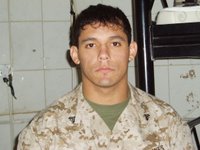
Cpl. Jordy Vega, a Texas native who graduated from boot camp in 2003, is on his third combat tour 3 short years. Shortly after arriving in Ramadi in September 2004, his HMMWV was hit by an IED. The vehicle was carrying 9 Marines, protected only by the hillbilly armor installed around the crew compartment. Rolling down the road, their lives were changed forever when the IED was triggered, a bright flash of light and wall of heat hitting the occupants full force. Cpl. Vega awoke to find an injured and unconscious Marine lying atop of him in the back of the burning vehicle. Under small arms fire, he helped drag a number of his wounded comrades to a casualty collection point, himself wounded in the leg from the shrapnel of the IED. He proudly showed me the scar on his right ankle, a permanent reminder of that day and his time in Iraq. A purple heart will adorn his uniform in the rear, a badge of honor among Marines.
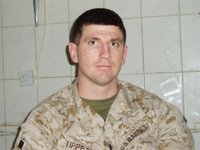
Major Bradford Tippett, the Battalion Operations Officer, summed up the actions of the Marines in his unit who do the job “no one else wants to do.” To liberally quote Major Tippett, “…the Marines do a job they don’t fully understand, but they know has to be done. The odds are often against them. They are scared and afraid but go out and do what’s required of them. The same kid, the same young men you wear out for getting drunk and stupid at 29 Palms is the same kid, who after a firefight, has done things that only giants of men do when they are here. They’ve done things we’ve only read about in the annals of history; that we’ve read about in the award citations from Guadalcanal and the Chosin Resevoir, things we wondered how anyone could do. I’ve seen it. I’ve watched these men, these Marines, do extraordinary things. They do phenomenal tasks that the American public will never have a full appreciation for, but should forever be appreciative of. These Marines are doing what they won’t. They are giants among men.”


 As you can see - I, too, disobeyed the general order, if only for a moment.


