Monday, October 24, 2011

Mules and Packhorses

“On the field of battle man is not only a thinking animal, he is a beast of burden. He is given great weights to carry. But unlike the mule, the jeep, or any other carrier, his chief function in war does not begin until the time he delivers that burden to the appointed ground…In fact we have always done better by a mule than by a man. We were careful not to load the mule with more than a third of his weight.”

- S.L.A. Marshall, The Soldier’s Load and the Mobility of a Nation, 1950

 
                                                                               Before packing...

In preparation for deployment, we were issued our gear/equipment from the CIF, or consolidated issue facility. Every Marine who has previously deployed knows the drill…it’s the same at every supply point, be it a Battalion warehouse or a base facility the size of the CIF. Show up, stand in line and wait…then wait some more. No matter what time of day or day of the week, it is almost guaranteed that a line has already formed at the door. 

For current deployments, the CIF regulates the type and quantity of gear a Marine draws from the facility. Unlike the hodge-podge collection of “off-the-shelf” equipment individually purchased by Marines during the early days of OIF/OEF, today’s gear list has been refined and contains equipment that rivals the Blackhawk, Bianci and Safari-land items that Marines had added to their combat load over the last decade. 

Gone are the days of H-harnesses, butt packs, ALICE packs and MOLLE packs. These days, Marines draw the same high-speed gear that was previously available only to professional mountaineers or expeditionary climbers. Today’s gear list includes improved load bearing equipment (ILBE), a fancy name for mountain backpacks. It also includes arctic parkas, booties and mittens; flame resistant outer-garments and fleeces of varying colors and thickness. No longer does a Marine have to scrounge for gear that’s appropriate for the varied climates of a particular geographic region. It’s all available at the CIF.

Enhancing the load is the addition of modern, technologically advanced protective gear, or PPE (personal protective equipment). Flak vests are relics of the past, replaced by modular tactical vests (MTV) complete with enhanced small arms protective inserts (E-SAPI) that weigh over 30 lbs. combined. The inserts are basically bullet-proof plates that protect the torso of the wearer. The plates may be heavy, but they’ll stop a bullet from most enemy rifles. Tack on the weight of the vest and the various attached accoutrements such as ammo magazines and your IFAK (improved first-aid kit) and you easily add an additional 45 lbs. to your torso. Of course, this doesn’t include the weaponry, clothing and personal items a Marine also carries into theater.

In 2003, the Corps drafted a combat load report that reported the average weights of gear that a Marine takes on deployment. The typical Marine carries 48 lbs of gear in his assault load, which is the average amount of gear carried during combat operations. The approach march load, part of which is shed before entering a combat situation, was estimated at 71 lbs.  Considering the existence load, or the total amount of gear that a Marines takes with him on deployment averages 138 lbs, is it any wonder that many Marines and soldiers alike suffer from back and shoulder injuries? Although the quality of today's gear has vastly improved, the Marine’s ability to carry that gear into battle has not changed in 235 years. Although S.L.A. Marshall noted “we were careful not to load the mule with more than a third of his body weight,” we have yet to find a more efficient - and plentiful - means of carrying equipment to the battlefield besides the grunt on the ground, the true packhorse of the Corps.  

           ....and after.

Thursday, October 20, 2011

Activation

After a 5 year respite, the Corps has finally decided to activate me again for deployment overseas. Although this was mostly a result of my own doing, I am excited, albeit somewhat anxious, to once again deploy in support of our global war on terrorism. My role has certainly changed, as I have moved on from my previous billet of USMC Field Historian. However, I will continue to post weekly observations "from the front" in order to provide an on-ground perspective of life in an active theater of war, without the typical political or media spin found in stories published at home. To be continued....

Wednesday, April 11, 2007

A Test of Faith


The evening was warm, virtually indistinguishable from the night before. It was the fall of 2005, just a month away from the first national elections in post-Saddam Iraq. A dozen young Marines relaxed inside the open porch of the Oasis, a crude plywood shack that served as chapel, watering hole and gathering spot for the Marines of Regimental Combat Team 8 aboard Camp Workhorse, a small "warrior base" nestled inside the larger confines of Camp Fallujah, Iraq. Amid the haze of half-smoked cigars and cigarettes, a single officer sat quielty, listening to the ebb and flow of conversation, knowing full well the good humor belied the events experienced by the Marines of the RCT over the previous days and weeks.

United States Navy CDR Dale C. White, then-Chaplain for RCT-8, 2nd Marine Division (forward) had become a father figure to most, a man whom many Marines would seek for guidance, comfort and encouragement. Despite his rank, the cross on his collar made him the most approachable officer in the battalion, which the Commander understood as one of the most important aspects of his job. From the moment he'd arrived in Iraq, Chaplain White knew his duties were much more involved than simply providing spiritual services. "I had probably 150 Marines from 8th Marine Regiment when I was at Camp Lejeune,” recalled White, a New York native. “Now I'm the pastor for 1200 Marines, because of all of our attachments (to include) tanks, tracks, the batteries, counter-battery, CEB...none of them came here with a chaplain. That was a surprise to me. I'm doing far more counseling, marriage counseling, coping with combat stress and those types of things, than I had expected." White waved at a young Marine strolling past, a freshly filled coffee mug in hand. "We've got an ongoing coffee mess from 0530 on," White says in response to the passerby. "We started brewing just one pot of coffee a day, now we're up to about twenty." Like many other men of the cloth, CDR White quickly became a shoulder to lean on, a man who'd listen without interruption, an officer whom junior Marines felt comfortable approaching despite the rank on his collar. "To realize someone (of such) rank is here to care for them," says White, "is a blessing. Here at the battalion, there's no bad time to talk. Come in whenever you want. If it's two in the morning, my RP (religious perogram specialist) will come and get me."

Since the creation of the first Continental Navy, chaplains have honorably served the United States Naval forces . Strictly noncombatants, they carry no weapons and are virtually forbidden to engage hostile forces. They include, but are not limited to Roman Catholics, Methodists, Lutherans, Baptists, and Protestants, as well as those of the Jewish, Hindu, Buddhist and Muslim faiths. Normally accompanied by an enlisted religious program specialist, or RP, they serve in every major Marine Corps unit at home and overseas. Inevitably, serving chaplains have died in action, sometimes in significant numbers. The U.S. Army and Marines lost 100 chaplains killed in action during WWII, a casualty rate greater per capita than any other branch of the services except the infantry and the Army Air Corps. Many have been decorated for bravery in action (five have won Britain's highest award for gallantry, the Victoria Cross). The Chaplain's Medal for Heroism is a special U.S. military decoration given to military chaplains who have been killed in the line of duty, although it has to date only been awarded to the famous Four Chaplains, all of whom died in the USAT Dorchester sinking in 1943 after giving up their lifejackets to others. (1)

Over the last 4 years, Operation Iraqi Freedom has offered no exception to the dangers facing today's Navy chaplains. Captain Bryan Weaver, former Division chaplain for the Second Marine Division (Fwd), Camp Fallujah, Iraq in 2006, commented on the effects of combat on Marines and Sailors who've served in Iraq. "Men who come out to a combat zone either find their faith or they lose their faith. Most Marines who come to a combat zone will use the opportunity to do a lot of soul searching. Even I do that. It's a great opportunity for reflection…and for honing our spiritual disciplines and spiritual direction. That's what I bring to the table as Division chaplain - I provide spiritual direction to the Regimental chaplains, who in turn to do so for the battalions." Reflecting upon his own experience in Iraq, Weaver continued. "When a chaplain goes out to a forward firm base or the front lines, the morale increases. We bring a sense of hope and stability to the Marines. It really encourages the Marines...it provides a sense of home (to them). It's important to be seen, not holed up behind a desk somewhere.” Captain Weaver paused, searching for an appropriate explanation. “It's leadership by example. I subscribe to MBWA - ministry by walking about. Men need encouragement. They feed off of that. Life out here is hard. A chaplain brings intangibles to the table - enthusiasm, attitude, spirituality. You can't put your hand on it, but you know when it's present."

Weaver's view of chaplains at war echoed the sentiments of New York Times best selling author Stephen Mansfield, who commented on the state of the military chaplains during a 2005 interview with the National Review online. Remarking on the progress they've made over the last three decades, Mansfield stated "Military chaplains are not chosen according to a denominational quota system as they were during the Vietnam era. They are chosen according to a “best qualified” standard. This means that the chaplains serving today are deeply committed to ministering to the fighting man and woman and have met very high standards for entrance into the corps. Some of them are even decorated warriors themselves who left the military and then returned as chaplains. They are doing a hard job gloriously." (2)

Doing a hard job gloriously came easy to LT William Stewart. Assigned to the II Marine Expeditionary Force (Fwd) in 2005-2006, LT William Stewart found himself ministering primarily to US Navy Seabees assigned to the tactical movement teams (TMT) of Naval Marine Construction Battalion 22. Originally enlisting in the Navy in 1984, Chaplain Stewart served as a religious program specialist for 5 years on active duty before entering the Naval reserves in 1989. Following the 9/11 attack on the World Trade Center and the Pentagon, Stewart applied for the US Navy Chaplain Corps and was subsequently assigned as Chaplain to his former unit, NMCB-22. "A lot of the duties are typical of what you think a Chaplain would be doing," stated Stewart. "I provide services, bible studies, prayer meetings and counseling. (In Iraq), I also do a lot of what I call movement prayers for TMT's, basically convoy escorts. You never know when there's going to be a convoy leaving the wire. I try to do a prayer before each of these if I'm available. It doesn't matter what time they leave, day or night, because I found that it really comforts folks to have that prayer.” LT Stewart smiles, recalling the reactions of his sailors. “Goodness, the stories of people coming up to me, saying "Chaps, I know that prayer saved us today"... is very humbling to me, because I don't feel like I have that much power. But I guess that person I'm praying to upstairs - hopefully, he did see them through - they believe in that, they trust in that; it gives them confidence."

Despite their commonalities in faith, the chaplains of OIF hail from a wide variety of backgrounds. LT Brian Crittendon was a former Marine Corps CH-46 pilot in the early 1980’s. Resigning his commission in 1985 to become a civilian chaplain, he spent 13 years as a civilian pastor before deciding to return to the military. In 2004, LT Crittendon reported to the Second Marine Division at Camp Lejeune, only this time in the uniform of a sailor, not a Marine. Deploying to Iraq in 2005, LT Crittendon set up shop inside a derelict rail car at the abandoned Al Qaim train station, commonly referred to as the “soul train” by resident Marines. Ministering to the men of 3rd Battalion, 6th Marine Regiment, Chaplain Crittendon faced one of his toughest days in November, 2005 when an insurgent ambush wounded 12 Marines and killed 4 of their comrades from 2nd Battalion, 1st Marine Regiment. Rushing to the forward rescuscitative surgical suite (FRSS), Chaplain Crittendon prayed over the dead and wounded. “I had two primary roles while I was down there. One was to minister to those who were hurt...to make contact with them, pray with them, encourage them and to bring them as much comfort (to them) as I can. The other is to keep an eye on the staff and to be a presence there (for) the spiritual encouragement of the staff." Crittendon continued. "There were points where I was putting my arms around surgeons and nurses and technicians who were having a long day....we stopped and I held prayer for everybody who was involved." Crittendon recalled the moment the Regimental Commander walked into the FRSS, encouraging his wounded Marines as surgeons struggled to save a fellow Marine who ultimately passed away from his wounds. "I view these men as being, in a sense, ministers to their country," said Crittendon of the Marines with whom he serves. "They have a mission...they've been called as much to their job as a warrior as I've been called to be a minister." Crittendon quickly changed the topic with a lighter comment . "The good news story for me, especially as a minister, (was when) a young man found his faith and asked me to baptize him a few hundred yards from the Syrian border, with his company...it will always be a highlight (for me) as a Christian minister."

Evey chaplain who experiences combat ministry comes away with a greater appreciation for the men and women they serve. "There's no doubt that being in combat, with rounds coming and IED's going off, that those Marines have a very different life than sailors on a ship," explains Chaplain White of RCT-8. "It's life or death (here). Whereas I can go on a cruise and come back with everyone alive, that's not the case here. There is definitely a level of committment and a level of risk that far exceeds anything we've had on a carrier.

Even though you could lose your life on a flight deck very easily, the rubber meets the road here.

1. Wikipedia Online - Military Chaplains
2. NRO - God and Man on the Front Lines, a Q&A by Kathryn Lopez, May 27, 2005

Thursday, February 01, 2007

A Coveted Award

The famous French Emperor and General Napolean Bonaparte once declared "A soldier will fight long and hard for a bit of colored ribbon." A European tradition usually reserved for royalty, the wearing of medals was uncommon among US Military pesonnel until the late 19th century, when civil war soldiers were awarded unofficial badges by local commanders, a practice later formalized by the services as a means to recognize the bravery and accomplishments of a military service member.

Having fallen out of favor since the civil war, the practice of beestowing unofficial awards upon deserving Marines has never completely disappeared. An number of unoffical decorations have been awarded to Marines over the last century, signifying a shared experience or common bond that will never be formally recognized by our Corps. Despite their unofficial status, however, these awards are often more coveted than all others combined.

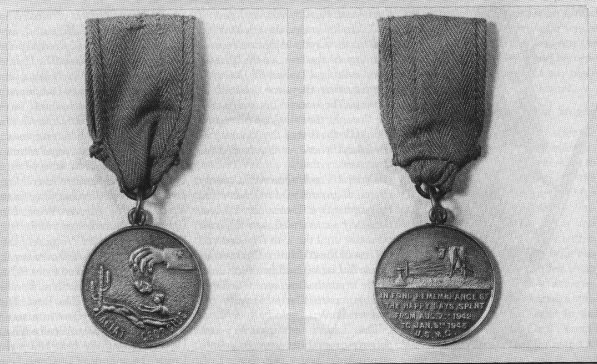
One such example is the George Medal. Legendary among 1st Marine Division veterans of Guadalcanal, only about 50 were cast in Australia before the mold gave out. According to retired Marine Col. Brooke Nihart, a Navy Cross recipient and historian who recently passed away in August, 2006, the George medal commemorated the difficult situation of the division during the early days on Guadalcanal, when ammunition, food, and heavy equipment were short and the Japanese plentiful. The Marines faced increasing Japanese air attacks and surface action which left the division in a tight spot.

In the recollection of then-Captain Donald L. Dickson, adjutant of the 5th Marines, the Division G-3, then-Lieutenant Colonel Merrill B. Twining, resolved to commemorate the occasion. Twining told Captain Dickson, an aspiring artist, what he had in mind. Captain Dickson went to work designing an appropriate medal using a fifty-cent piece to draw a circle on a captured Japanese blank military postcard.


When the division departed Gudalcanal and finally reached Australia, a mold was made by a local metal craftsman and a small number were cast before the mold became unserviceable. Those wanting a medal paid one Australian pound for it and received a certificate as well. The medals are now an even greater rarity than at the time. In recent years, reproductions have been cast, and can be identified by the different metal and a poor definition of details.

The obverse design of the medal shows a hand and sleeve dropping a hot potato in the shape of Guadalcanal into the arms of a grateful Marine. In the original design, the sleeve bore the stripes of a vice admiral, intended to be either Vice Admiral Robert L. Ghormley, ComSoPac, or Vice Admiral Frank Jack Fletcher, Commander Joint Expeditionary Force, but the final medal diplomatically omitted this identification.


Also on the obverse is a saguaro cactus, indigenous to Arizona, not Guadalcanal, but representing the code name for the island, "Cactus." The obverse inscription if Facia Georgius, "Let George Do It." Thus it became known as the George Medal. The medal's reverse is inscribed: "In fond remembrance of the happy days spent from Aug. 7th 1942 to Jan. 5th 1943. U.S.M.C."

Much like Lieutenant Colonel Twining, US Marine Corps Major Joe Winslow hoped to commemorate his wartime experience. However, Major Winslow's would occur nearly 60 years later in 2004, far away from the island of Guadalcanal. Instead of water and jungle, he was surrounded by sand, and the enemy were not Japanese. They were insurgents and were battling Marines of I MEF (Fwd) on the streets of Fallujah.

As the MEF slowly pushed through the city, then-Captain Winslow recalled the unique, historical significance of the George Medal and was inspired to create a similar award for his fellow Marines who'd already served or would soon serve in the billet of Field Historian during Operation Iraqi Freedom. A unique, independent position carried out by only one or two Marines at a time, the Field Historians traveled throughout the theater, recording the oral histories of Marines engaged in combat operations and combat service support, while simultaneously collecting documents and artifacts for archiving at the Gray Research Center and the National
Museum of the Marine Corps in Quantico.

Captain Winslow hand sculpted his concept in plaster, pouring a firing mold from concrete and other materials found at the MEF headquarters. The medals' design was based upon an Iraqi army badge, with a Marine Corps eagle, globe and anchor super-imposed on a Persian star, surrounded by palm fronds. The colors of the suspending ribbon are scarlet, black and silver, which respectively represent the blood of Marines shed in OIF, the lives given in support of their fellow Marines, and the Field Historian's fidelity to history. Captain Winslow's first prototype was cast in Fallujah using silver sent from a texas silversmith. The remaining
versions were later cast at home by a Marine Corps Guadalcanal veteran.

Dubbed the Military Order of St. Nicholas, the medal was presented by Major Winslow to 13 Field Historians during their 231st Marine Corps Bithday celebration in Fredricksburg, VA, all of whom had previously deployed to Iraq is support of the Global War on Terrorism. Each recipient received a certificate which declared them a "companion" in the Order. The award was named after Colonel Nicolas Reynolds, the former Commanding Officer of the Marine Corps Field History Unit who assembled the first team of Marine Corps Field Historians to deploy to Iraq. Since the start of OIF, approximately 15 Marine Corps Field Historians have deployed to Iraq.

Like the George Medal, the Military Order of St. Nicolas will be shared by a finite group of people for a limited period of time. Worn only at events or gathering attended by members and of the Field History detachment, the Military Order of St. Nicolas will forever serve as a reminder of time spent in the Al Anbar Province of Iraq, watching and recording history in the making.


The George Medal Information was obtained directly from a US Marine Corps Historical Division WWII Publication on Guadalcanal.

Thursday, October 26, 2006

The Men and Their Stories - Wounded Part 4 (Final)

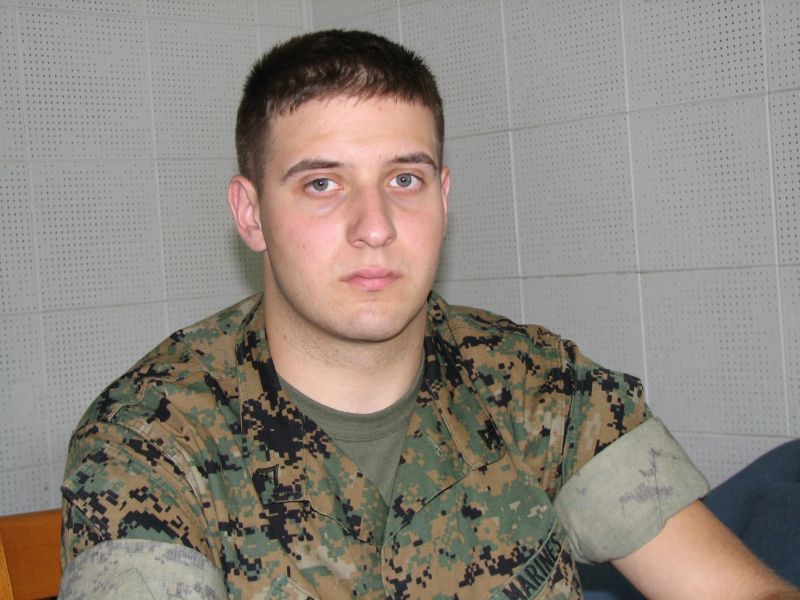
Although the majority of the Camp Lejeune wounded warriors claim the title "Marine," a few of the residents prefer the nickname "Doc." Hospitalman first class (HM1) Glenn Minney is one of the few sailors who've come to call the wounded warrior barracks their home. A Navy reservist, Minney enlisted in 1985. "Doc" Minney was activated and deployed to Iraq in January, 2005. While serving with 3rd Battalion, 25th Marine Regiment, he was wounded by mortar shrapnel while standing atop the Haditha Dam, a 10 story high facility that serves as a Forward Operating Base for Marines and Corpsman stationed near the Euphrates River Valley. "It was a typical, hot day in Iraq. I had to go out to one of the CONEX boxes to get supplies for the Battalion Aid Station...and the dam came under mortar attack. I was out on the 10th deck on a catwalk and a mortar round went off about 30 feet in front of me." HM1 Minney remembered running back inside the dam, the unit going to General Quarters as four additional rounds exploded near the dam. At the time, he did not know he was injured. "My vision was a little blurry and I had a severe headache, but I didn't think much of it," Minney stated. The next day, however, his eyes started bothring him, and he began receiving treatments for pink-eye. Unknown to the "Doc", however, both retinas in his eyes had become detached from the concussion of the blast. Blood vessels had ruptured, allowing the vitrouse fluids to leak from his eyes. "I started developing tunnel vision, and it was slowly closing in, becoming pinpoint. I talked to my Battalion Surgeon, and sat him down in private and told him 'I am going blind'." Medevac'd to Al Asad, then to Balad, an opthamologist recommended immediate evacuation to Hamburg, Germany for surgery. His first surgery lasted 3 hours, and he received two more operations before heading home to the United States. On September 2, 2005, while convalescing at home, his vision again went black and he required additional emergency surgery. Still on active duty orders, he was offered the opportunity to move into the wounded warrior barracks in the fall of 2005. "At times, you can't talk to your spouse, your mother, your father, friends, about things they've never been exposed to. Being around people who've been there, and having the medical facility...that's the benefit to having the wounded warrior program. Care is first priorty, whether it be mental, physical or social - we go out of our way to hit all those avenues."

Monday, October 23, 2006

The Men and Their Stories - Wounded Part 3

LCpl. Peter Dmitruk, an 0311 with Kilo Company, 3rd Battalion, 6th Marine Regiment, arrived at the Wounded Warrior barracks in September, 2005. Having graduated from boot camp less than one year earlier, he returned to Camp Lejeune with a career's worth of experience. Deployed to the Syrian border in the summer of 2005, LCpl. Dmitruk became accustomed to the daily grind of snap vehicle check points, presence patrols and security patrols around town. Having just returned from patrol to his company's battle position, he was reaching into his pack which he'd tossed atop the hescoe barrier that provided cover for him and his fellow Marines. "A mortar had fallen pretty close...I didn't hear the mortar, but I felt it. It felt like I kinda got punched. My arm flew up into my body. I looked down and it was mangled...kinda looked like it had gotten caught in a shredder. I could see the blood, which looked like arterial bleeding." A company corpsman laid him down and injected LCpl. Dmitruk with morphine. "I remember laying down on the stretcher, apologizing to everyone for getting hurt. I didn't want to leave." A medevac helicopter landed shortly thereafter and took him to the forward resuscitative surgical suite (FRSS) at FOB (forward operating base) Al Qaim. "I remember asking the Batalion Commander if I could stay...one of the medical officers (was) there; I could see he shook his head, so I knew I was going home. He said 'this is your time to heal, you've done what you can'." His injuries resulted in the introduction of a titanium plate into his arm, a necessity after losing nearly five inches of bone. Skin was grafted from his leg to cover the wounds and hasten the healing process. Following numerous surgeries, LCpl Dmitruk moved into the Wounded Warrior barracks in January, 2006 and has since realized the significance of living there, vice convalescing at home or in his unit's barracks. "I realized that when I'm here (in the wounded warrior barracks), healing is the number one priority...you'll always find a way to get to your appointments. That's the reason you're here, to heal and to get better."

Tuesday, October 17, 2006

The Men and Their Stories - Wounded Part 2

Born and raised in Augusta, Georgia, LCpl Phillip Tussey enlisted in the Marine Corps in October, 2003. His first duty assignment with Kilo Company, 3rd Battalion, 8th Marine Regiment would prove to be his most memorable. Deployed to the city of Ramadi, Iraq in the winter of 2006, LCpl Tussey was on foot patrol in one of the most dangerous cities in Iraq when a sniper's bullet found its mark. "I felt something sting my leg. I tried to stand up...I fell to the ground, trying to get myself back up...I put my hand on my thigh and (pulling) my hand back, there was blood on my hand. I knew I'd been hit." The bullet had hit him inside his left thigh, 8 inches below his hip. Two fellow Marines picked up LCpl Tussey and put him in the back of a hardback HMMWV, his squad still under fire. Spent .50 cal cartiridges from the M-2 Browning machine gun atop the HMMWV turrent were hitting him in the face as the gunner provided covering fire to his squad. "They started medevac'ing me. There was only a driver and a gunner in there, so I picked up the radio and was calling the Staff Sergeant, telling him that we were up and that we needed to roll." Despite the pain from his shattered leg, LCpl Tussey remained conscious until he went into surgery at Charlie-med, Camp Ramadi's field surgical unit. Flying out of Ramadi the same evening, he traveled through Baghdad and Balad before flying to Germany, where he spent the following four days in a morphine induced haze. "They put a rod from my hip to my knee in my leg and two screws in my hip to hold the rod in place," described Tussey, who has endured numerous surgeries since his wounding. He's been at the Wounded Warrior barracks since June 28, 2005. "I can't really do much right now, because of the crutches," says LCpl Tussey, although he has not let his limited mobility keep him tied to the barracks. In July, 2006, he traveled to the National Naval Medical Center at Bethesda, MD with Lt. General Amos, former Commanding General of II MEF, to visit other wounded Marines and sailors returning from Iraq. Encountering a wounded Corpsman from own unit, Tussey recalled the Corpsman's comments upon seeing the unexpected visitors. "The (wounded) Corpsman that we knew couldn't thank us enough. He was so happy (to see us). He said 'you don't know what this means for y'all to come see me.' "

Friday, October 13, 2006

The Men and Their Stories - Wounded Part 1

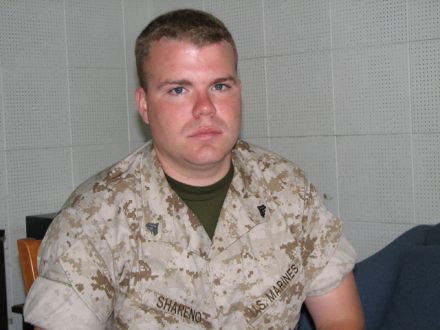
Corporal Aaron M. Shareno deployed to Iraq on July 18, 2005 with 2nd Battalion, 2nd Marine Regiment (2/2). Serving near the city of Karma, Iraq, Cpl. Shareno was 5 months into his deployment when he was wounded by a suicide vehicle-borne IED on December 14th, just 11 days before Christmas. His platoon had established fighting positions near a palm grove, approximately 25 meters from the edge of the road, when an insurgent drove his vehicle into the side of a 7 ton truck, detonating the explosives and instantly vaporizing the vehicle. The explosion sent shrapnel and chunks of metal through the air, knocking Cpl. Shareno and other Marines to the ground. "I got blown forward and a piece of shrapnel traveled through my palm and blew out the left matacarpal in my thumb - just shattered it," recalled Shareno. "When I got blown forward, I remember thinking I'm dead...I fell to my side and felt something was funny, not right...I saw my thumb drooping down...blood flowing out of my palm. It nicked two arteries in my hand. I put pressure on it below the wrist to stop the bleeding." Cpl. Shareno lauded the fast reaction of the Corpsman who treated him on the scene, but could not remember his name. "If I saw his face, I could recognize (him)", Shareno said. "He slapped a tournaquet on my hand...it was a unique experience." Medevac'd to Camp Fallujah Surgical, then ultimately to Balad and Germany before flying back to the United States, Cpl. Shareno regretted not being able to finish his deployment in Iraq. " I was a little shook up...more angry than anything...I (was) two months out (from leaving); ready to reenlist (when) I get hit. I just wanted to finish my pump, I wanted to reenlist and I wanted to continue on with my Marine Corps career." Now at the Wounded Warrior Barracks at Camp Lejeune, Cpl. Shareno is much less angry and is not letting his injuries get in the way of his career. "I plan on retiring from the Marine Corps," says Shereno. "I'm staying til I don't have fun anymore. Right now I'm having tons of fun."