Sunday, October 16, 2005

A New Course of Action

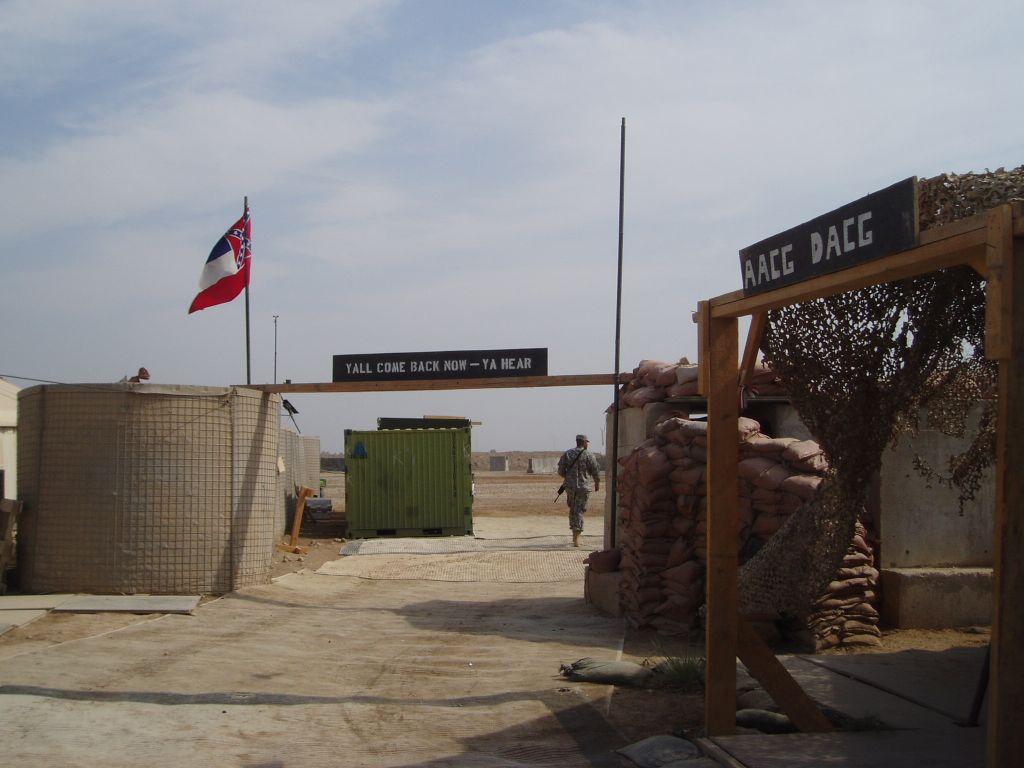
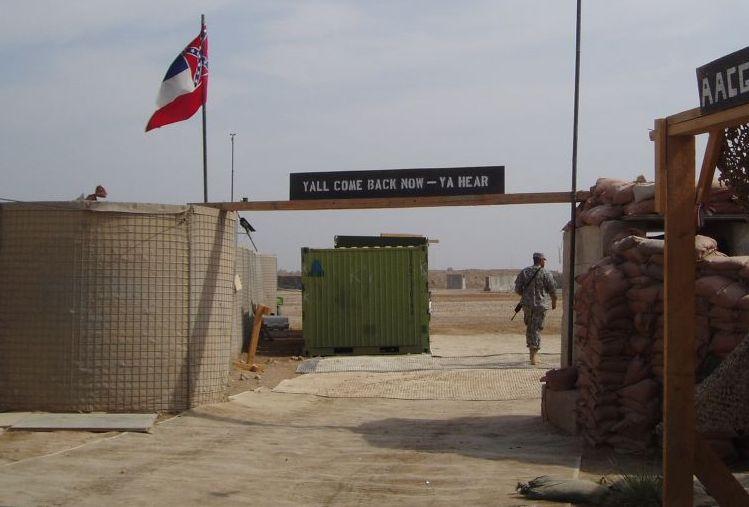
The entrance to the FOB Landing Zone, or LZ, reads
"Y'all Come Back Now, Ya Hear?


October 16, 2005

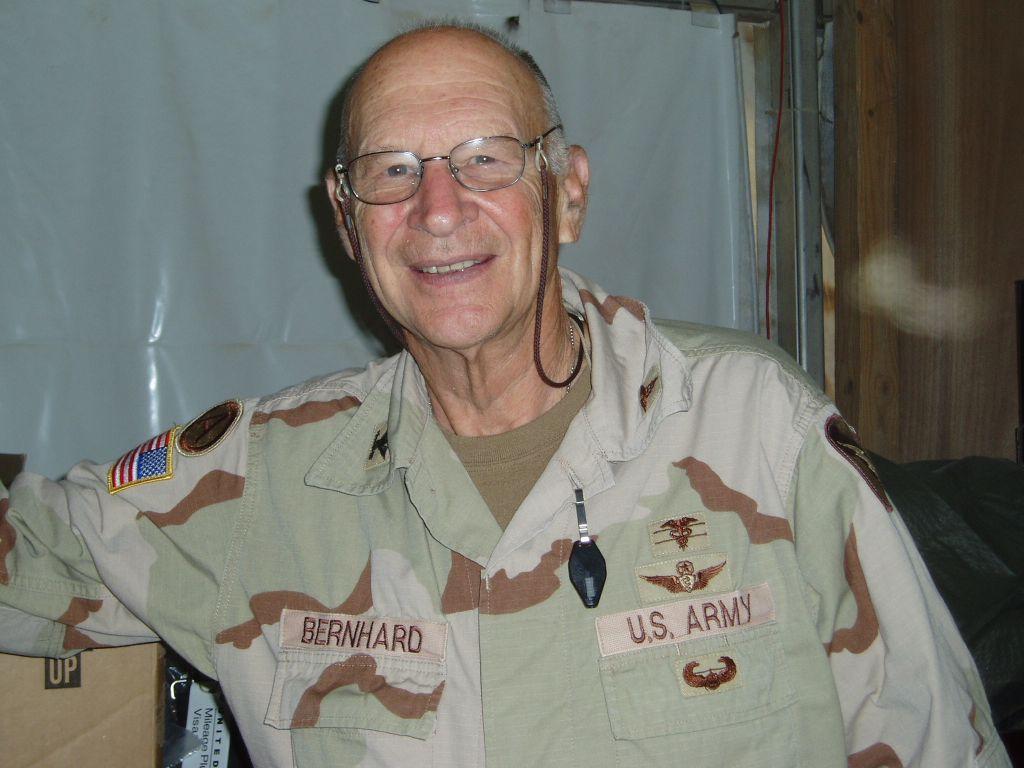
My visit to the 155th Brigade Combat Team was a great opportunity to learn about my Army brethren. The Mississippians were a great bunch of guys and lined up some fantastic soldiers for me to speak to, including the most "senior" active duty soldier in Operation Iraqi Freedom. My very last interview was with Colonel William N. Bernhard, M.D., Brigade Surgeon for the 155th.

Colonel Bernhard is 74 years old, and originally enlisted in the Marine Corps in 1950. He was medically discharged from the Corps in 1951, which he steadfastly claims was life's greatest disappointment. Unhappy as a civilian, he pursued a career with the Naval Medical Corps and by 1963, was honorably discharged as a Lieutenant Commander (0-4). Still in love with the military lifestyle, then LCDR Bernhard approached the Army Reserves and received his US Army commission in 1979, working under the First US Army Augmentation Detachment.

He has served in dozens of hot spots around the world to include service with the an MP Brigade at Camp 301, Hofra-el-Betin, where he provided medical care for 15,000 Iraqi prisoners of war (EPW's) in 2001. Subsequent to a tour in Afghanistan in 2003, he was again called back to active duty from the retired roles to serve as the Brigade Surgeon for the 155th BCT. An amazing man with impeccable credentials - I was honored to meet and spend time with this living legend.

After returning to Camp Falluja, I reported to the office of the Commanding General for my "better late than never" in-call. Major General Stephen Johnson commands the entire II Marine Expeditionary Force (Forward) ... aka: II MEF (Fwd), which includes the US Army forces with whom I just spent the last week. The CG provided some great insight into the current operational situation and suggested a change or two in my intended course of action. As anyone with military experience would agree, I quickly "readjusted my battle plan accordingly." Looks like I'll be spending some time in the field with our Marines from the 2nd Marine Division, with whom I served as a young Lieutenant. I now have a new course of action. More to come.

Wednesday, October 12, 2005

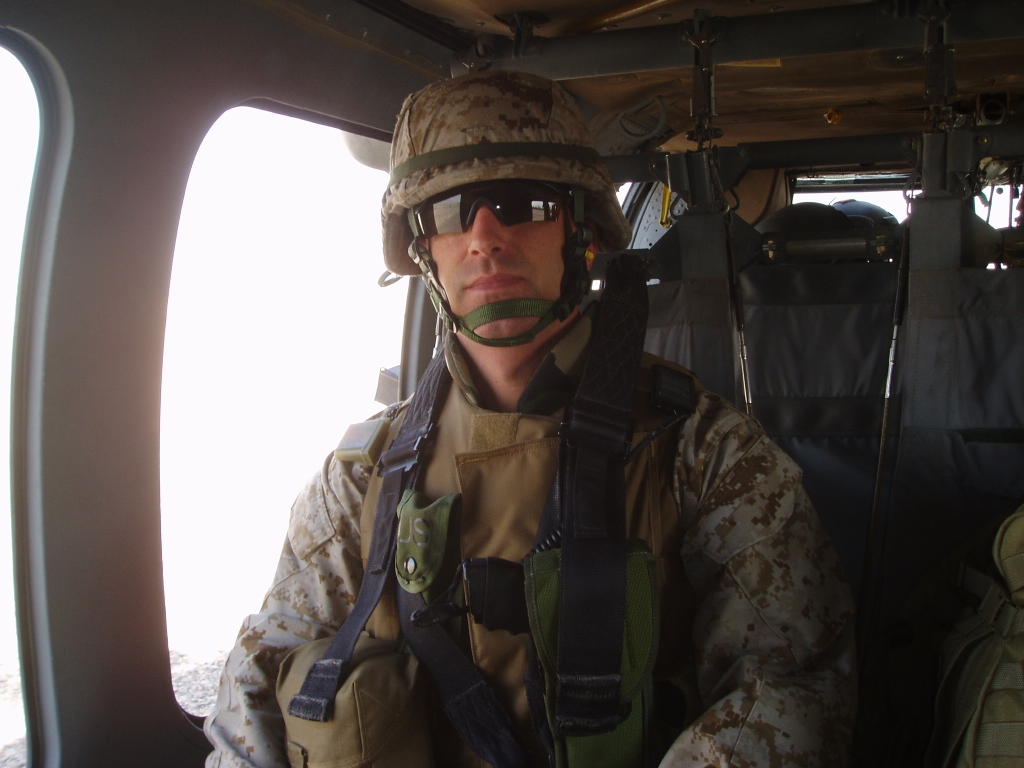
A snapshot for mom.
Taken aboard my flight to the 155 BCT. (10/08/05)

Army Life

I left Camp Fallujah this morning, boarded a US Army Blackhawk helicopter at LZ East and traveled southeast toward Al Iskandariya. I arrived at the forward operating base, or FOB, well before noon. This particular FOB is the home of the 155 Brigade Combat Team (155 BCT), and is much less built up than the relatively stable Camp Fallujah. Until a month or so ago, soldiers at the FOB were still wearing their body armor 24/7, as the insurgency is still alive and active in small pockets around the area of operation (AO). Since January 1st, the insurgents have fired over 130 mortar rounds and an occasional rocket into the confines of the base, causing a number of casualties and a decent amount of damage. Recently, an extremist drove an SVBIED (suicide vehicle-borne improvised explosive device) into the entry control point (ECP) and detonated the bomb. Fortunately, an Iraqi vehicle in front of the suicide bomber suffered the brunt of the damage. However, the poor soul driving the vehicle was killed in the blast. He was simply a local worker who earned his living selling trinkets on base to U.S. soldiers.

The journey to the FOB was quite a rush – certainly more exciting than flying Marine Air, which flies almost exclusively at zero dark-thirty. The Blackhawk is incredibly smooth and quiet, much like comparing the ride in a Mercedes to that of an old Dodge pick-up. Army pilots, I am told, enjoy tree-top level flying and hugging the ground during their daylight runs. In pairs, we glided effortlessly over the tops of palm trees, across the roof-tops of crude brick houses that dot the landscape. An occasional updraft signaled an oncoming power line or other man-made structure of considerable height. Looking down, it seemed we rarely reached altitudes of more than 200 feet. Despite the threat of small arms fire, the ride was smooth and uneventful. Knock on wood.

I was greeted at the LZ by Major Erby Montgomery, the Public Affairs Officer, or PAO, for the Brigade. Maj. Montgomery offered to set up my visit and I could not have asked for a better way start to my TAD. With my helmet in hand, we walked from the LZ into the base camp and straight to the Major’s office. Maj. Montgomery had already secured a spot for me to work and immediately introduced me to a number of the Brigade staff, including the Commanding General. On deck for less than 15 minutes, I was already briefing the General on my objectives for the week. By sunset, I had completed a number of oral histories with the Brigade staff, finishing the first days’ collection by dinner. In the morning, I’ll meet with soldiers of the 2/11 ACR, or Armored Cavalry Regiment.

October 10, 2005

The FOB is much smaller and more rustic than the major camps found at Al Asad or Camp Fallujah. FOB’s are temporary in nature, often torn down or dismantled after a set period of time. Several have already been turned over to the Iraqi Security Forces (ISF) and are now homes to the newly created army or Iraqi police. A tangle of Hescoe barriers, concrete bunkers and tents, the FOB is a miniature “tent city.” Most working spaces are housed under canvas and cammie netting, with the Headquarters element utilizing the few hard-stand buildings found within its perimeter. Thousands of sandbags dot the landscape since incoming mortar fire tends to destroy or damage anything not protected by layers of dirt and concrete. Only one explosion awoke us last night, most likely an IED going off somewhere outside the FOB. It detonated at exactly 0032 hours (my watch glows in the dark). I’m glad it was the only one for the evening - I didn’t have to get out of the sleeping bag and head to the bunker. I’m told it’s been unusually quiet…I must have brought the “calm” with me.

The Brigade arrived last January to an area that was rife with insurgent activity. Task Force 2-11 (ACR), the ground maneuver element headquartered at the FOB sent its subordinate units throughout the AO to conduct kinetic operations for the first 4-5 months on deck. Virtually every Brigade soldier from cook to supply clerk earned his combat action badge since arriving. Cordon and knocks, raids, presence patrols, TCP’s, vehicle and personnel searches, dynamic building entries – all have been utilized in the AO. As the insurgency is displaced, operations shift from a kinetic to non-kinetic environment while civil-military operations (CMO), information operations (IO) and humanitarian aide take the place of traditional war-fighting, shifting it farther out of the AO.

CMO and information operations go hand in hand and support the adage of “winning the hearts and minds of the people.” With any CMO action, we seek to improve the critical infrastructure of the towns and cities. We must convince the Iraqis that they are in a better situation than they were before the fall of Saddam. We will fail to win them over if we do not fulfill the promises we’ve made to them; mainly security and income. Democracy and freedom are empty words to many, as they have never lived in an environment that permitted free speech or freedom of action. Unfortunately, I believe the concepts of freedom and democracy are forever lost on the current generation, while security and stability will be the primary factors that influence the mindset of the average Iraqi.

The average Iraqi understands the irony of American presence in their country. They want us to leave, yet understand their organic security forces are neither strong enough or mature enough to protect them and their families. The Americans provide food and water, without which they would starve. However, we continue to provide free hand-outs vice forcing them to cultivate their fields and produce crops. We are unwittingly creating an overly-dependent population rather than a self-sufficient population. Only time will tell if our continuing CMO and IO will change that situation. Around FOB Kalsu, CMO and IO continue to occupy the minds of the senior staff.

Monday, October 03, 2005

Generals and Barberchairs


October 3, 2005

I turned in my Field Historian “concept of operations” to the II MEF (Fwd) Chief of Staff, Col. John Ledoux. Unlike previous OIF deployments, the current MEF staff is somewhat concerned about spare LtCols wandering around their AOR’s. Rightfully so. Fortunately, Major Major General Stephen T. Johnson, the MEF CG, indicated he was “historian friendly” during our first meeting in the hallways of the MEF HQ. Perhaps now I can get out into the field without ticking off someone important.

Subsequent to turning over my CONOPS to Col. Ledoux (a Sarasota, FL native), I sent an e-mail to Brigadier General Augustus (Leon) Collins, CG for the 155 Brigade Combat Team, affectionately known as the "Mississippi Rifles." I requested permission to visit the Commanding General’s AOR northeast of Karbala within the next week, as the 155 BCT has supported II MEF for months. I was surprised to receive a direct response from General Collins, who stated he’d be happy to oblige, just 30 minutes after sending him my request.

Older than the state of Mississippi and the seventh oldest infantry unit in the United States, the 155th Infantry, formerly the First Mississippi Regiment, was handed its first commission on 1 June 1798 by Winthrop Sargent, territorial governor of Mississippi. It was during the Mexican War, that the 155th Infantry, then the First Mississippi Regiment, was commanded by the great Jefferson Davis, who resigned his seat in Congress to assume command. At Buena Vista, 22 February 1847, with the Mexicans out-numbering the Americans five to one, General Zachary Taylor called upon Jefferson Davis and the First Mississippi Regiment. Moving quickly into the assault, Davis gave but one order: “STAND FAST, MISSISSIPIANS.” History was made that day and the order became the official motto for the unit, later to be emblazoned on the unit crest. Through the Civil War, in engagements in Kentucky and Tennessee; in the Spanish-American War; in World War I, at Beauregard and in France, and in World War II, in the Southwest Pacific, the men from “Mississippi’s Pride” were always among the finest. Though not Marines, they’ve become part of the II MEF (Fwd) team, as fine as any Marine Corps unit in the AO.

On a personal note, I hope to speak with the officers about one of their fallen comrades, Captain Lowell T. Miller, VMI class of 1993.

JACKSON (AP) - A Mississippi National Guard unit in Iraq has captured the insurgent who killed one of its soldiers during a firefight last month, the unit's commander said. Capt. Lowell T. Miller II, 35, of Flint, Mich., was serving with the Mississippi National Guard's 155th Infantry Battalion, 155th Brigade Combat Team when he was killed by small arms fire during a raid in Iskandariyah on Aug. 31
.
"Capt. Miller volunteered to transfer from the Michigan National Guard to the 155th Infantry Battalion so he could deploy to Iraq with this unit," said the battalion's commanding officer, Lt. Col. John M. Rhodes, in an e-mail from Iraq." Just by his request, I knew Tom was a patriot and a warrior," Rhodes said. "Many people seek to avoid combat deployments, but Tom was willing to risk everything in order to deploy with a group of soldiers who he did not even know."

During a raid on a suspected insurgent stronghold, Miller was shot and later died despite desperate attempts to save his life, Rhodes said.Information obtained from five suspects who were detained just after the attack and tips provided by local Iraqis helped the unit to identify the man responsible for the fatal shooting, Rhodes said Rhodes said the unit raided the suspect's home and captured him last week and he will soon appear before an Iraqi judge.

Miller's primary job in Iraq was to train Iraqi soldiers, Rhodes said. "Tom was extremely dedicated and always led by example. He was a hero to his soldiers," Rhodes said. "Tom will continue to live through us, and we will carry on his legacy." Miller came from a military family. His father served 22 years in the Naval Reserves and his brother and sister have both served in Iraq.

"Dad, I serve so others don't have to," he once wrote to his father, Lowell Miller. "You taught me to be a leader, to stand up and sacrifice so others would not have to. You were in the military and served so your kids wouldn't, yet we do. You taught us well."

Miller graduated in 1993 from Virginia Military Institute and later joined the Michigan Army National Guard. He was part of the 155th Brigade Combat Team in Iraq, which is made up of nearly 4,000 Mississippi Guard soldiers and others from throughout the county. The unit is attached to the II Marine Expeditionary Force and operates in the Karbala, Najaf and Babil provinces of Iraq.

On a lighter note, I met an interesting Marine the other day while passing by the barbershop inside the II MEF Battle Square. Gunnery Sgt. James L. Johnson was the II MEF (Fwd) Security manager for OIF 4-6, having previously deployed to OIF-1 and OIF 2-2. He finally went home yesterday and I was sad to see him go, as we had just become acquainted and I rather enjoyed his company. Besides his official function as II MEF (Fwd) Security Manager, Gunny had the distinction of being the MEF’s unofficial barber. Gunny could be found in his “barbershop” after 1800 hours nightly, cutting hair for free, though accepting donations if offered.

As we chatted, I noticed the Gunny’s unique barber chair and upon closer examination, shook my head at the ingenuity of our young sailors and Marines deployed in theater. The barber chair is actually a Mitsubishi van seat, welded to a USMC 7-ton truck rim. Underneath the plywood flooring, the rim has been affixed to a .50 caliber ring mount pulled off of a destroyed vehicle, which allows the barber chair to traverse 360 degrees. A young “sea-bee” from Naval Mobile Construction Battalion 1 used his welding skills to craft a footrest, made of scrap metal from a damaged HMMWV. The chair has been used by Privates and Generals, to include Genrals Sattler and the current Deputy CG, Brigadier General Patton. Now that's a piece of history that belongs in a museum one day!

Sunday, October 02, 2005

Leaf Eaters


October 1, 2005

We dropped back an hour last night. Could’ve actually made it to chow this morning.

I finally received my laptop computer back from the CE (Command Element) Help Desk – that’s the section of Marines who control the entire internet domain within Camp Fallujah. Typical of any computer section worldwide, the CE Help Desk is not well regarded among Marines outside of its walls…It took 4 days for them to switch my domain from Quantico to Camp Fallujah – although the work itself only takes 10 minutes. Seems they would be better labeled the CE “we’re not that much” Help Desk.

I ran across another VMI classmate last night. Major Tom Voytko ’87 recognized me as we passed each other in the dark. Tom is a reservist who never really left active duty. Shortly after ending his active duty career in 2001, he joined the reserves and was immediately recalled to service following 9/11. After that, Tom was held over for OIF 1, and continues to serve today. Tom is also the recipient of a bronze star, received during a previous deployment to Iraq. Although actually a recalled reservist, he’s never spent enough time in the civilian world to seek employment outside of the Marine Corps.

As Tom and I were talking, an artillery fire mission commenced from nearby, the 155 rounds sent forth in support of our grunts on the ground in Iraq, most likely somewhere near Baghdad. The ‘boom’ of the big guns startled me slightly, as the guns had been shifted to a location fairly close to our position. The Arty guys have an acronym for themselves – FAKOB – Field Artillery, King of Battle. No one who has seen the results of an artillery barrage will argue that moniker.

Over the past few days, I have spent the bulk of my time interviewing Marines employed within the ISF Directorate (Iraqi Security Forces), part of MNF-W (Multinational Forces – West) in Falluja. The ISF Directorate has many subordinate units, to include the DBE, the P3, IPLO’s and the BTT’s. Each provides a distinct service within the Directorate.

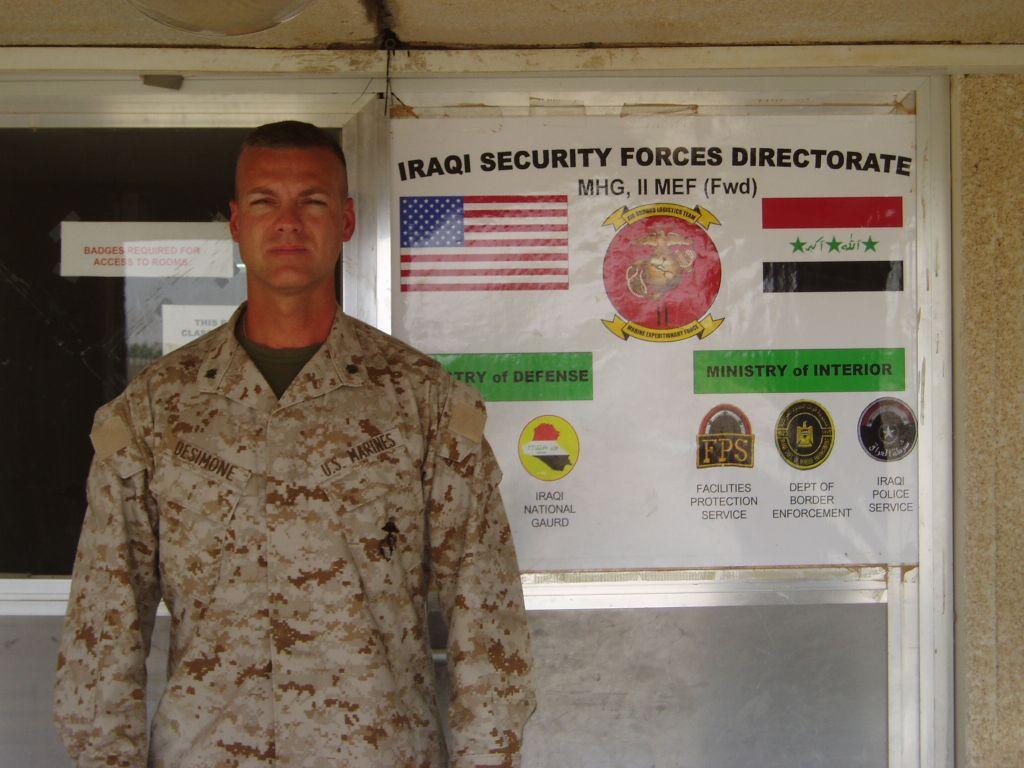
The DBE, or Department of Border Enforcement, is charged with setting up Iraqi border forts on the borders of Iraq, Saudi Arabia and Jordan. LtCol Ken Desimone is the coordinator of the DBE. Ken has been a friend of mine since we were Lieutenants together at Camp Lejeune in the late 80’s. Ken has served in the reserves for over 20 years and has been informed by his wife that this will be his last hoo-rah. Ken agrees, of course. Ken’s office has spent the last 8 months or so traveling to the Iraqi border, overseeing the construction of border forts, to include the training, equipping and mentoring of newly trained Iraqi border patrol units. Ken was recently the subject of a news story which got quite a bit of attention within the MEF – it can be read by searching the internet for "LtCol Desimone Iraq." That's Ken in the photo above.

Ken and I served together in the II MACE, or II MEF Augmentation Command Element at Camp Lejeune from 1998-2001. We also deployed to Italy together for three weeks during Operation Agile Lion, a Joint Army & Marine Corps exercise in Vicenza, Italy. Ken likes to think he’s “saltier” than me, and we always trade barbs when we see one another. Ken threw a new one at me the other day when he called me a “leaf eater.” A little confused, I asked him what he meant – Ken replied that since I’m here in a non-combat arms position, I’m just a “leaf eater” as opposed to the grunts, who are “meat eaters.” We had a good laugh over that one.

In addition to interviewing Ken and his folks, I spent time with the BTT, or Border Transition Teams, as well as with Marines from the P3 Program, short for “Police Partnership Program.” The Marines from P3 are responsible for training the IP’s or Iraqi Police Candidates from the city of Fallujah. Since April, over 1200 Falluja IP’s have been trained at the Jordanian and the Baghdad Police Academies.

Over the next week, I’ll be attempting to head south near Al Iskandariyah to link up with the US Army’s 155 Brigade Combat Team (BCT 155), who is deployed to Iraq in support of II MEF (Fwd). They have seen quite a bit of action over the last year, yet we have not had anyone embed with them to date.

Thursday, September 29, 2005

7 days

September 23, 2005

Still three days out from catching a helo to Falluja, SSgt Fay and I have been trying to keep busy and not step on Tim Crowley’s toes. Tim, my fellow the Field Historian at Al Asad, has already established a group of contacts within the airfield boundary and has interviewed many of the commands present. Tim has also ventured out and about with several units and has obtained some excellent field interviews of units subsequent to their patrols in hostile territory.
Today, I asked Tim if he’d like some assistance on any of the interviews he had lined up. Having a couple extra bodies to help knock out some interviews is a always a good thing, so we ventured down to Camp Ripper, home of Regimental Combat Team 2 (RCT 2), and met with a subordinate unit made famous by some recent press coverage, Lima Company 3/25.

You may have seen press coverage on Lima Company last month. A Marine Corps Reserve Infantry Company from Ohio, Lima Company was conducting a mission in August near Haditha Dam when one of its Amphibious tractors, known as an AMTRAC, or an AAV, struck a buried IED, or improvised explosive device. The IED was massive, and the fireball that consumed the AMTRAC instantly killed 15 Marines onboard. Only one Marine survived the explosion. The 25-ton vehicle was thrown in the air like a tonka truck, flipped over by the force of the blast and instantly set ablaze, with little chance of survival for its unfortunate occupants. This was not Lima Company’s first combat casualty, either. In May, another AMTRAC transporting Marines from Lima Company struck an IED. Sgt Samuel Balla, 1st Squad Leader, 1st Platoon, recalled the instant the Trac hit the IED. A bright flash of orange, then red light filled the cabin, followed by a blast of incredible heat and eventually, nothing but pitch black darkness. As the Trac filled with smoke, wounded but surviving Marines tumbled out, spilling from the troop hatch, Sgt. Balla included. It wasn’t long before ammunition inside the burning Trac started cooking off, exploding from the intense heat and flame. Four men never made it out of the Trac.

In addition to Sgt. Balla, I also spoke with Major Stephen Lawson, the Commander of Lima Company. Lawson is a consultant in his civilian life, and never dreamed his unit would take more casualties during their deployment than most any other single combat unit in Iraq. Nor would he imagine losing so many Marines to the horrible explosions that are slowly becoming a daily reminder of how cruel war can be.

During our interview, Major Lawson was quick to point out that his Company was one of the only qualified units available to conduct such dangerous missions. Many of his men are being nominated for valor awards, for bravery under fire. I am sure that he, among others, considers every Marine in his unit a hero. They have seen the horror of war first-hand, have lost close friends and coworkers. These Marines have endured hardships most of us will never know. Their pride was evident as I sat among these heroes in their crowded tent. I left the tent that afternoon humbled by the courage of these young Marines.

September 24, 2005

Today I ran into a VMI classmate of mine, Major Ken Devero, who is currently assigned
to II MAW G-3 staff. Ken and I have not seen each other in a decade, and it was great catching
up on the last 10 years. Ken was originally planning to go into the Navy following
graduation from VMI, but his grades kept him from the commission he wanted. After several
years and job ventures, Ken approached a Marine Recruiter and was eventually accepted into the Marine Corps Officers Candidate School in 1991. Now an electronics warfare officer in an EA-6 Prowler squadron, Ken is in the 15th year of his Marine Corps career. As with most VMI classmates who see each other after many years, we had a great time “talking story” and catching up on each others lives. We even stole a few minutes to get a photo for the VMI Alumni Review, which is mailed quarterly to every alumnus. If history holds true, we will see it in print no sooner that the fall 2008 issue.

September 27, 2005

Today we are in Falluja, home of the II Marine Expeditionary Force (II MEF). The MEF is the largest body of Marines assembled within the AOR, and is comprised of subordinate Regimental Combat Teams, Infantry Battalions, Force Service Support Battalions, Companies and Detachments, as well as a host of other cats and dogs like myself. The MEF is basically the Command element for the entire Marine fighting force within Iraq. Major General Johnson is the Commanding General in charge of II MEF and also controls a number of Army units and Iraqi Defense Forces (IDF) throughout the area of operations (AOR).

Our flight to Falluja took place at night under the cover of darkness. Again, most flights and convoys are done at night to decrease the risk to deploying personnel. Pilots and air crew wear special night vision devices to see through the darkness. Their night vision goggles, or NVG’s, pick up the faintest glow from stars, the moon, or flickering city lights below and in essence, magnify it in a way that permits the wearer of the NVG’s to see everything as if it were daytime, though in an eerie, green hue. Every so often, you catch a flicker of the greenish hue surrounding the darkened silhouette of the air crew as they turn their heads away from you, resembling some sort of space alien from Star Wars.

The flight itself was typical as military helicopters go – loud, hot and cramped. The rear hatches remain partly open as you ride through the darkness, and the smell of aviation exhaust permeates the inside of the helicopter. Air crews are fond of saying “don’t worry if it leaks – it’s when it stops leaking that you’ll have to worry,” referring to the dozens of exposed hydraulic lines throughout the interior of the fuselage. It’s a common for grease and oil to spatter your uniform if you’ve spent any amount of time inside a Marine Corps helicopter. Maybe that’s why all the aircrews wear jumpsuits!

We made one stop at a different location, switching helicopters. This required us to lug our gear off the first bird and onto the second. In addition to my ballistic vest with its heavy SAPI plates, I was also carrying a loaded MOLLE pack and two fully loaded seabags containing everything I brought with me to Iraq. As Falluja will be my base of operations for the duration of my deployment, I did not leave anything behind in Al Asad. This made for a quick, unplanned workout as I struggled to walk across the runway to our new point of embarkation with everything in hand. By the time the helo touched off, we were all soaked to the bone with sweat, the heat trapped between our bodies and our body armor.

Transient personnel arriving at Camp Falluja stay overnight in a large tent containing over 100 cots, four rows deep. Two exist aboard the Camp – one for men and one for women. Only in Iraq have I ever seen tents with air conditioning. Similar to the tent I stayed in last year at Saddam’s former Presidential Palace in Baghdad, the tent had air conditioning units installed on each facing wall every 20 feet. Each were set at 16 degrees Celsius – I’m not sure what that translates to in Fahrenheit, but I think a side of beef would have remained indefinitely edible in that tent. It’s a good thing I had my sleeping bag and poncho liner handy or I would have gone outside to share a sweet spot in the sand with the camel spiders.

I spent the day checking into the MEF, trying to explain my purpose to most Marines I met. Unfortunately, the Field History Division is relatively unknown by most Marines, and seldom will you find a Marine who understands our mission until it has been explained in agonizing detail. However, most Marines are fascinated once they realize the scope of the mission and want to get in on the action, particularly when they find out we are basically our own boss in the AOR. I can’t tell how many times I’ve been asked by Marines how they can be part of the unit. Earlier today, the personnel clerk at the admin processing center admitted he had never seen blanket travel orders before being presented with my and SSgt Fay’s orders. We are indeed a rarity within the Marine Corps.

The Camp is no different than any other base in Iraq. It is a hodgepodge of tents, ISO (shipping) containers, prefabricated trailers, existing Iraqi buildings, and plywood construction covering hundreds of acres. Units of all shapes and sizes occupy areas throughout the base, with little apparent organization to the untrained eye. Concrete jersey walls and Hesco barriers are everywhere, as is concertina wire and plywood guard towers, or OP’s (observation posts). The Hesco barriers are so abundant in Iraq that they are beginning to blend in with the landscape. A Hesco is nothing more than a large cardboard box that contains dirt and is wrapped in steel gauge wire – it is a highly effective barrier against small arms fire and shrapnel from indirect fire of mortars and rockets. I wish I had a small portions of the money Mr. Hesco has made from this little war.

A shelter made of Hesco barriers stacked atop each other. This shelter, located at a military camp in As Samawa, Iraq, can hold 50 personnel inside.

I spent dinner with four of my fellow agents from the Naval Criminal Investigative Service (NCIS), each deployed to Camp Falluja in general support of the MEF. I was already acquainted with 2 of them – Scott Milburn and Doug Einsel, and it was Doug who stayed up through the wee hours of the morning to pick up a couple of sweaty, stinky Marines from the helicopter landing pad at the Camp. NCIS currently has agents deployed throughout the theater, conducting criminal investigations, strategic counter intelligence support, and forensic assistance to the many Navy and Marine Corps units deployed. It was nice to see some friendly faces and catch a ride in the NCIS suburban, as I’m sans ride here in Camp like most Marines. The NCIS agents had a long day yesterday when the responded to the suicide death of a young Marine who’d only been in country a couple of days. An unfortunate tragedy, the Marine apparently took his own life with his service weapon. It’s something I’ll never understand.
Thursday, September 22, 2005

Arrival....Again!

September 22, 2005

We arrived at Al Assad Air Base at 0200 hours, the night bright with stars and lights from inside the belly of the C-5 Galaxy that had ferried us for the last 14 hours. Among the group of Marines accompanying me were 17 K-9 handlers and their dogs. During a 4-hour refueling stop in Rota, Spain, the handlers had the opportunity to walk their dogs and get some fresh air. I had no idea how many dogs were actually in the cargo hold and was amazed as dog after dog came off the C-5, all acting like typical house pets, jumping at their handlers and licking their hands, happy to be out of the roaring plane. However, looks can be deceiving – each dog is specially trained to detect a variety of substances, from narcotics to explosives, as well as acting in the capacity of attack dog on command. These are no simple house pets; I enjoyed watching them but made sure to steer clear of them when their handlers walked by.

We also had several AH-1 Cobra attack helicopters inside the C-5, dwarfed by the size of the huge cargo hold. A passenger compartment lies above the cargo hold and can only be accessed by ladder once inside the aircraft, or by using roll-away stairs similar to those used on some of our older commercial aircraft. Each seat in the upper compartment faces rearward, and there are no windows, much less movies or snacks to make the flight enjoyable. Toward the end of our flight, the crew warned us the flight into Al Assad would be a bit different than what we’d experience at home, as the approach would be fast and the descent steep. The ride in was similar to an roller coaster ride, complete with unexpected dips and turns. Fortunately, roller coasters don’t face the threat of being shot by SA-7 missiles.

We were met by several dust-covered Marines once inside the air terminal and briefly welcomed aboard. Everything occurs in the hours of darkness – it’s safer that way. As our seabags came off the plane, still strapped to their pallets, we split into groups. Many were going on to other bases – Falluja, Baghdad, and smaller forward operating bases (FOB’s), while several were to remain in Al Assad. Al Assad is a joint air base, meaning each service component has personnel assigned within its gates. It is also home to the II Marine Air Wing, or II MAW. Hundreds of Marine aviators, aviation support personnel and other MOS’s are deployed aboard the base. We finally hit the rack at 0400 hours and had a restless night.

This morning, Lieutenant Colonel Tim Crowley, the current Field historian on deck, took us for a brief tour of the base. Tim had borrowed a vehicle from the II MAW S-4, and was more than happy to show us around. Nearly every Marine on base walks or runs everywhere they go, and the use of a vehicle is usually reserved for troops leaving the base, or by those units owning tactical vehicles such as HMMWV’s or 7 tons. During our drive, I was surprised by the sheer number of Russian MIG’s littering the area surrounding the airfield. Saddam’s Air Force had obviously made great efforts to move the aircraft from their hangars before US Forces bombed the airfield. None remain operational, though some still resemble the mighty flying aircraft they once were. Hidden among oasis trees as well as scattered across the open desert, most have been spray painted with graffiti by US troops, their guts strewn out across the ground.

Throughout the day, we were introduced to officers and troops from various subordinate units on Al Assad. Our most interesting stop was the Sgt. Major’s office at Regimental Combat Team 2 (RCT 2), adorned with a dozen weapons seized by RCT 2 from Iraqi insurgents. The weapons, many older than me, ranged from pistols to mortars. Homemade rocket launchers made of PVC pipe displayed the ingenuity of their makers. By dinner, we had visited many units, and finished off our “tour” with a stop at the Morale, Welfare and Recreation (MWR) building recently built on base. The MWR building houses pool tables, fussball tables, a big screen television, and an internet cafĂ©. A home away from home, it provides the young Marines and soldiers a welcome bit of relief from the hot sun and long hours. Only the impact of indirect fire from insurgents would break many of these Marines away from their games.

We have requested air transport to Falluja, but may have to rely on ground convoy due to other operational commitments. It is there that I will attempt to embed with subordinate units of the 2nd Marine Division, my old Command at Camp Lejeune. Many are headed to the field, and I hope to join them in fight against the insurgency. Until then, I’ll continue to explore Al Assad, and attempt to develop some well-needed contacts within the aviation community. You never know when they’ll come in handy when you are in the field.

Wednesday, September 07, 2005

Hurry up and Wait

There’s an old saying nearly every Marine has said or heard at one time or another in his career…“Hurry up and Wait.” Unfortunately, that’s exactly what I’ve been doing since returning to active duty in early August. A series of events have delayed my intended travel to Iraq, most notably the devastation wrought on the Gulf Coast by Hurricane Katrina. On August 28, 2005, Katrina rolled through Louisiana and Mississippi, flooding the towns of New Orleans, Biloxi, Mobile, and numerous other coastline communities. A co-worker compared the resulting disaster to Mogadishu, Somalia, where bands of looters roamed the city in search of food, or other items. The situation in New Orleans immediately brought to mind the aftermath of September 11, 2001, where the city of New York was left in tatters following the collapse of the World Trade Center. To some, it seemed the odds of rebuilding were insurmountable. For weeks following the attack, everyone wondered how we would recover from such a disaster. However, will and determination are remarkable elements of human nature. We’ve become stronger in our resolve, and the survivors of Hurricane Katrina will also be stronger despite the horrors they’ve seen and endured.

If my current travel schedule holds true, I should depart the US via a C-5 military flight on or about September 16. The largest of all military aircraft in the fleet, the monster C-5 can hold half a dozen Greyhound buses in its cargo hold. A straight, but lengthy flight straight to Iraq if all goes well, though I won’t hold my breath. “Hurry up and wait” has a way of following you regardless of your location and situation.

I will be accompanied by Staff Sergeant Michael Fay, one of only 2 official combat artists in the United States Marine Corps. SSgt Fay returned from Afghanistan in April/May 2005, where he was embedded with 3rd Battalion, 3rd Marine Regiment (3/3), spending his time in Camp Blessing, Wazir Pass, and Jalalabad. SSgt Fay’s drawings are currently archived in the Marine Corps Historical Division and will hopefully appear on the walls of the National Museum of the Marine Corps, currently under construction outside Quantico Marine Corps Bases alongside I-95. The museum is scheduled to open on November 10, 2006, the birthday of the Marine Corps.
I recently received an e-mail that questioned my return to Iraq. The writer indicated I should be going to the Gulf Coast instead, helping our own citizens stranded in New Orleans or Biloxi. While I understand their feelings, it is not my choice whether I serve my country in Iraq or within our own borders. I serve at the pleasure of our Commander in Chief, the President of the United States. The President, backed by Congress, has determined that it is vital to the security of our nation that we remain in Iraq until such time that the Iraq Government can safely and securely protect its citizens. The Iraqis are simply not ready to do so. To leave now would negate any forward progress we’ve made in the shaping and building of the Iraqi security forces. Until such time comes, the insurgency will continue to prosper. We are the “fence line” that separates the borders of security and insurgency. Regardless of ones political persuasion, we are there, and will remain until it is safe to hand over the reigns to the Iraqi government.

If it were not for the requirement to deploy to Iraq, I would certainly endeavor to travel south and assist with the recovery efforts in Mississippi and Louisiana. However, I have been assigned my lot in life, and I must carry on with my assigned task. In response to the aforementioned e-mail, I ask only that each of you reflect on your own situation and consider the extent to which you’ve served your country and your neighbors. Be it community or military service, charity work or donations of your own time and money, I ask you to focus your energy on your own actions (or inaction, if appropriate), not the actions of others. It’s tempting to sit back and play “armchair quarterback,” but actions speak louder than words. If your response to the events in Iraq, Afghanistan, Hurricane Katrina, 9/11, or any other major event was stuck in the “hurry up and wait” mode, now is the time to act vice coaching from the sidelines. Whether you Agree or disagree with the politics in play, now is the time for you to make a difference.